For The World's Most Beautiful Watches

At PaddleWaves, we love everything horology. We want to provide an expert service in terms of scholarship, transparency and above all we want our community to buy the very best the market has to offer.

FOR THE
WORLD'S MOST
BEAUTIFUL
WATCHES

SHOP NOW

Current Selection

Patek Philippe 3589
Patek Philippe 3589
Patek Philippe 3589 in yellow gold
Case Back of Patek Philippe 3589

Patek Philippe ref.3859/1 in Yellow Gold

The dial of this 1980s Patek Philippe Ref. 3859/1 inevitably calls to mind Kazimir Malevich’s Black Square, painted in 1915 — an expression that reduced vision to its most essential form.

The dial composition is exceptionally restrained. The outer section is crafted in warm white mother-of-pearl, revealing a soft, fluid lustre under the light; at its centre lies a deep black onyx panel, like a frozen “absolute form.” This black-and-white construction is not merely a contrast of materials, but a conceptual dialogue: light and void, space and substance.

Unlike traditional decorative dial designs rich in ornament and narrative, this Ref. 3589/1 strips almost everything away, leaving only the most fundamental visual order. The black onyx recalls the square in Malevich’s painting, symbolising purity and ultimate abstraction, while the mother-of-pearl surround acts like an infinitely extending field, giving the entire dial a sense of depth within stillness.

In a certain sense, this is not merely a wristwatch.

It is a wearable work of Suprematism.

Sales Status
    AVAILABLE
$25,000.00
Cartier Crash Paris
Cartier Crash Paris
Cartier Crash
Cartier Crash

Cartier Crash Paris 1991

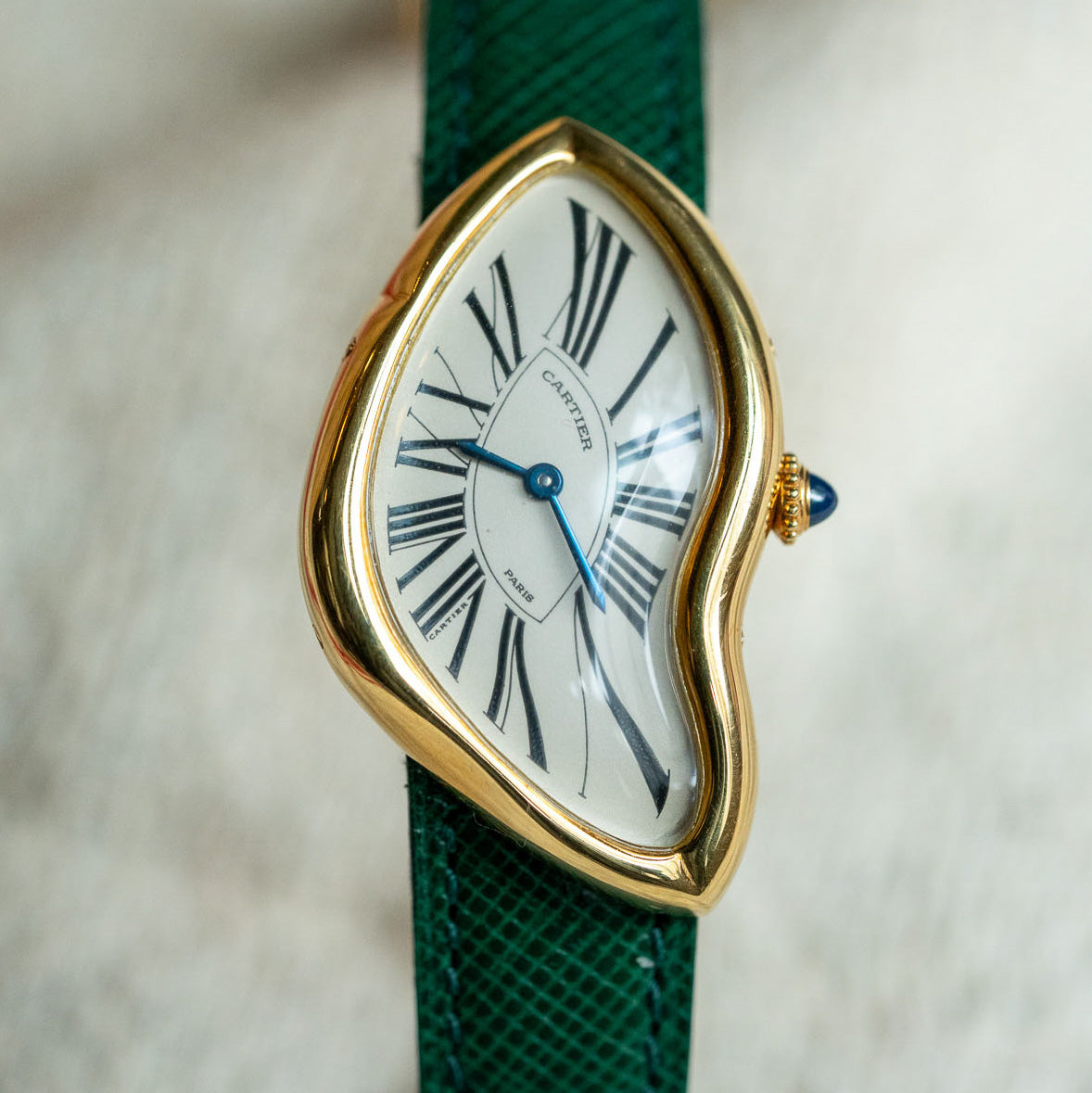
There are watches, and then there are objects that feel almost impossible, pieces that seem born from imagination rather than design. The Cartier Crash 1991 Paris is one of those rare creations.

A direct descendant of the legendary Cartier Crash London, this version carries the same dreamlike, distorted silhouette: softly melted, beautifully unbalanced, and instantly recognizable from across any room. It is not just a watch; it is a quiet rebellion against symmetry, a celebration of form over convention.

Crafted in France and limited to only 400 pieces, this 1991 Paris edition holds a special place in Cartier’s history. It is among the last Crash models produced before the brand shifted fully to “Swiss Made,” marking the end of an era where London and Parisian artistry defined its most daring creations. There is a certain warmth, a certain soul in these earlier pieces—something that feels increasingly rare.

On the wrist, the Crash doesn’t simply tell time: it bends it. It draws the eye, starts conversations, and lingers in memory long after it’s gone.

Sales Status
    SOLD
$0.00
Rolex 6265
Rolex 6265
Rolex Daytona 6265
A close-up of a wrist wearing a stainless steel Cosmograph Daytona 6265 with a cream dial.
Rolex Daytona 6265

Rolex Daytona ref.6265 with Cream Dial

If you had to choose one Daytona that distills everything great about the manual-wind era, which would it be?

For me, the answer is the ref. 6265.

It brought together everything Rolex had developed in the generations before it. The metal tachymeter bezel preserved the original Daytona look established by the 6239. The screw-down pushers first seen on the 6240 were further refined, while the upgraded Cal. 727 introduced with the 6262 and 6264 was carried forward. In many ways, the 6265 represents the final and most mature expression of the classic Daytona.

Its enduring appeal is reflected in its production run. Unlike the shorter, more experimental generations that came before, the 6265 remained in production for nearly two decades. Over that long history, it appeared in several rare variations, including the cream dial featured here.

Produced around the turn of the 1980s, these examples may technically have silver dials, but instead of the usual cool metallic sheen, they display soft shades of ivory and cream. Against this warmer background, the black registers and bright red “DAYTONA” signature become especially striking.

What fascinates me is how a chronograph originally designed to express speed and mechanical precision has been softened by time, taking on an unexpectedly warm character.

And somehow, of all the Daytonas I have shown, this cream-dial 6265 is the one I have heard women say that they like the most, to my pleasant surprise.

Sales Status
    SOLD
$0.00
Lange 1 in Stainless Steel
Lange 1 in Stainless Steel with detail of dial
the case back of Lange 1 in Stainless Steel
Sideview of Lange 1 in stainless steel

Lange 1 in Stainless Steel

The A. Lange & Söhne Lange 1 in stainless steel, Ref. 101.026, is one of the most legendary creations within modern Lange collecting.

The Lange 1 itself is the defining watch of Lange’s revival after 1994. With its off-centre dial architecture, oversized date and manually wound Calibre L901.0, it established a distinct aesthetic order that could only belong to A. Lange & Söhne. Yet the stainless-steel case elevates this example beyond the language of the standard catalogue, turning it into one of the rarest exceptions in the Lange universe.

Compared with Lange 1 examples in yellow gold, white gold or platinum, the stainless-steel version does not rely on additional complication to assert its importance. Instead, its power lies in the contradiction of its material, its extremely limited production, and its almost mythical status among the most serious Lange collectors. In the world of A. Lange & Söhne, stainless steel is far rarer — and in many ways more precious — than gold. Never listed in any official catalogue, the steel Lange 1 has often been described by international collectors as “mythical,” its tiny production only deepening its aura of mystery.

Yet the legend of this Ref. 101.026 goes even further.

This is not an ordinary retail example. Its first owner was Mr. Stefan Muser, a figure deeply connected to the early revival of A. Lange & Söhne. During the golden era in which Günter Blümlein and Walter Lange rebuilt the manufacture, Mr. Muser was not only closely associated with this remarkable chapter in horological history; through his singular position within the industry, he was also able to commission and own this exceptionally rare stainless-steel example.

Without adding any further complication, this watch stands at the summit of Lange collecting purely through the anomaly of its material, its extraordinarily low production, and its remarkable provenance.

An object not to be sought, but to be encountered — a tribute reserved only for the most discerning collectors who truly understand its significance.

Sales Status
    SOLD
$0.00
Patek Philippe 2552
Patek Philippe 2552
Dial of Patek Philippe 2552
sideview of Patek Philippe 2552
Case back of Patek Philippe 2552

Patek Philippe ref.2552 in Yellow Gold

At Sotheby’s recent spring auction, a platinum Patek Philippe Ref. 2552 achieved HKD 6 million, making it clear that collectors’ enthusiasm for the reference remains exceptionally strong.

Ref. 2552 is powered by Patek Philippe’s first-generation automatic movement, the Cal. 12-600AT, widely regarded as one of the most beautiful movements ever made by the manufacture. It was used only during the 1950s in a small number of references, including the 2526, 2551 and 2552.

Compared with the better-known Ref. 2526, the Ref. 2552 — despite sharing the same 12-600AT movement — was produced in only around one-fifth of the quantity. Across all metals, just over sixty examples are known to have surfaced. Within such limited production, examples preserved in excellent condition are even more difficult to find. On this particular 2552, both the hallmarks on the lugs and the 18K mark inside the caseback remain remarkably crisp.

Then there is the design of the 2552 itself. It features a stepped, layered bezel and case middle, similar to its sibling reference 2551, but with straighter and more architectural lines. What makes it even more compelling is the way the lugs are simplified and set back behind the case middle. These recessed lugs allow the stepped surfaces of the bezel and case body to be fully revealed. Together with the “PP” crown, slightly sunken into the case, the watch creates a subtle sense of floating tension — giving rise to its nickname, the “Disco Volante,” or flying saucer.

Sales Status
    SOLD
$0.00
Patek Philippe 3940
Patek Philippe 3940
Patek philippe 3940 on the wrist

Patek Philippe ref.3940 in Yellow Gold

What kind of watch would the head of Patek Philippe choose to wear? For former president Philippe Stern, the answer was the Ref. 3940.

Since its introduction in 1985, the 3940 remained in production for nearly two decades, evolving through three series while retaining its enduring appeal. It stands at the threshold between vintage and modern Patek Philippe, opening a new chapter for the perpetual calendar through rigorous thinking and restrained expression.

First, the dial. The 3940 abandoned the day and month aperture display used on references such as the 1518 and 3448, and instead redefined the visual language of the automatic perpetual calendar through a balanced three-register layout. The sub-dials at 3, 6 and 9 o’clock respectively display the month and leap year, the date and moon phase, and the day and 24-hour indication. Each register serves a dual function, allowing the dial to remain compact, orderly and highly legible. The open space at 12 o’clock is balanced by a clean, sharply executed Patek Philippe signature. As a result, although the watch is mechanically complex, its visual presence is remarkably simple and modern.

The pursuit of elegance and thinness also extended to the movement. The 3940 is powered by the Cal. 240Q, whose off-centre micro-rotor is integrated into the movement rather than stacked above it, significantly reducing overall thickness. To compensate for the smaller rotor’s reduced winding mass, Patek Philippe used 22k gold, achieving greater density within a smaller volume.

By quietly containing the complexity of a perpetual calendar and the convenience of automatic winding within a case scarcely thicker than a Calatrava, the 3940 never presents complication for complication’s sake.

That, perhaps, is the true charm of the Ref. 3940.

Sales Status
    SOLD
$0.00
Photo of Patek Philippe 1593
Sideview of patek philippe 1593
Sideview of Patek philippe 1593

Patek Philippe "Hour Glass" ref.1593 in Platinum

Patek Philippe introduced the Ref. 1593 in 1944, and production continued until around 1967. Collectors know it as the “Hour Glass,” a name inspired by the way its case flares outward at the lugs before narrowing toward the crown, creating a distinctive hourglass silhouette. The faceted crystal further accentuates the graceful waistline of the case, together forming a sculptural and highly expressive design.

Approximately 1,000 examples of the Ref. 1593 were produced, of which only around one quarter were cased in platinum. As this example demonstrates, platinum versions were often paired with rectangular diamond hour markers, giving the watch a cooler, sharper, and more commanding character.

Sales Status
    SOLD
$0.00
Rolex 4431 in rose gold

Rolex ref.4431 in Rose Gold

Rolex Ref. 4431 was born in the 1940s, during a period before the brand’s mythology of tool watches had fully taken shape. It represents one of the rare Rolex creations with a more experimental spirit and a distinctly hand-finished, decorative character.

Its rose-gold case is paired with distinctive crab-claw lugs, giving the watch a silhouette that feels both classical and subtly sculptural. The hand-guilloché dial adds a rich three-dimensional texture, allowing the surface to reveal delicate variations of depth and light from different angles.

Ref. 4431 represents a lesser-known side of Rolex: classical, elegant, and refined, with the charm of a high-grade dress watch.

Sales Status
    SOLD
$0.00
Patek Philippe 1593 in rose gold
Patek 1593 sideview

Patek Philippe ref.1593 in Rose Gold

Patek Philippe Ref. 1593 is one of the brand’s most captivating post-war shaped dress watches. Commonly known as the “Hour Glass,” it takes its name from the hourglass-like silhouette of its case, with the sides narrowing toward the centre and flaring outward at the top and bottom.

Its raised, faceted crystal creates subtle shifts of light across the silvered dial when viewed from different angles. The case, made by the celebrated Geneva casemaker Markowski, houses the rectangular Cal. 9-90 movement, perfectly in harmony with the case shape. From the front to the side, from the case to the calibre, the watch maintains a remarkably coherent design language.

Total production is believed to be around 1,000 pieces, with rose gold examples accounting for only approximately one quarter. The accompanying Gay Frères bracelet is double-signed by Patek Philippe, and its matching rose-gold construction further enhances the rarity and completeness of the watch.

Sales Status
    SOLD
$0.00
Patek Philippe 2508
Patek Philippe 2508
Bezel of Patek Philippe 2508
Dial of Patek Philippe 2508
Crown of Patek Philippe 2508
Patek Philippe 2508 in yellow gold

Patek Philippe ref.2508 in Yellow Gold

The beauty of some watches lies in their geometric beauty. Everyone knows Patek Philippe’s Ref. 96 and Ref. 570 as classic Calatravas, but the 1950s Ref. 2508 has been gaining serious momentum lately. So what makes it so universally appealing?

To me, it comes down to three details.

First—though this applies only to the early versions of the 2508—there are its square, multi-faceted hour markers paired with tapered, triangular indexes, a combination that makes the watch instantly recognizable at a glance. Within these, my favorite is the earliest variant with a 1/5-minute track on the outer ring, because the outer and inner sections show a subtle two-tone effect. It creates a layered effect: quiet, but incredibly refined.

Second is the way the lugs curve downward, backed by a case construction with a rotating waterproof caseback. It feels muscular and athletic, yet the lines remain smooth and elegant. Beyond the caseback, it also features a dust cover designed to guard against magnetism, dust, and moisture, which is an impressively modern solution for its time.

Third, and this is my personal favorite, is the large blued seconds hand sweeping across the dial. Even among early dials, some versions come with gold hands, which makes the overall look lower in contrast. A heat-blued steel hand, on the other hand, brings an extra layer of character and playfulness to the dial.

Given that the 2508 was never produced in large numbers to begin with, finding a truly well-preserved example is naturally difficult. But finding one that also checks every box collectors love—fully “optioned” with the most desirable traits—is even more a matter of luck.

Sales Status
    SOLD
$0.00
Patek Philippe 2586
Patek Philippe 2586
Side view of Patek Philippe 2586
case back of Patek Philippe 2586
Sideview of Patek Philippe 2586

Patek Philippe ref.2586 in Yellow Gold

Ref. 2586 proves why Patek Philippe, within the world of dress watches, is the one brand that defines the entire category.

At first glance, it looks like a Ref. 570-like three-hander—Dauphine hands, powered by the 27 SC calibre with central seconds—its dial perfectly balanced. But the more you study it, the more its details reveal something entirely different.

The bezel is slightly recessed, creating a subtle inward-tapering profile. This is meant to echo the watch’s most artistic signature: four twisted, fluted lugs—each one individually hand-finished and then soldered onto the case.

A restrained dial paired with an opulent case—this is the most literal expression of what makes vintage Patek Philippe so beautiful.

Sales Status
    SOLD
$0.00
Patek Philippe 3445
Patek Philippe 3445
Bezel of Patek Philippe 3445
Sideview of Patek Philippe 3445
Caseback of Patek Philippe 3445
Lug of Patek Philippe 3445
Dial of Patek Philippe 3445

Patek Philippe ref.3445 in Yellow Gold

There’s a moment in design history where everything shifts—quietly, but permanently. The Patek Philippe Ref. 3445 feels like that moment.

Introduced in the 1960s, it marked a new direction for the brand: the arrival of the automatic Calatrava with a date. But more than a technical milestone, it represents a change in attitude. Earlier Patek watches often leaned soft, ornate, almost romantic. The 3445 is something else entirely—clean, deliberate, modern.

The case says it all. Sharp, angular lugs cut with intention. A slim, architectural profile. There’s no excess here—every line feels resolved, every proportion considered. It has that unmistakable mid-century confidence, the kind you’d expect to see slipping out from under a crisp cuff in a Mad Men-era boardroom.

And yet, the dial keeps it grounded. Simple, balanced, quietly elegant. The date complication adds function without disrupting the harmony. It’s this tension—between precision and warmth—that gives the 3445 its enduring charm.

Then there’s the detail collectors dream about: an original factory sticker still present on the caseback.

A small, almost insignificant thing—until you realize what it means. Decades passed. Preserved. A watch that has somehow moved through time without losing that first moment of existence.

Sales Status
    SOLD
$0.00

FIND MORE